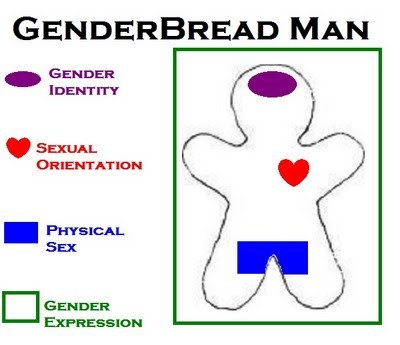
(Image from: LGBT Presentation by Janea Hubbard)
If you’ve been out in the gay community, you may have encountered some of these labels by now: Femme, Lipstick Lesbian – Butch, Stone Butch, Stud – and the many in-betweens (Chapstick, Boi, Soft Butch, Androgynous, Switch, Stem, Futch). It might be necessary to leave some blanks in case any more varieties spring up in the future of the lesbian crop: ______, ______, ______ …
What type of lesbian are you? Have you ever thought about it? Do you fit into any of the above mentioned categories, or are you a potential filler for one of the blanks? And most importantly,
Does it matter?
Life being a journey, it can take years and many experiences to develop an full understanding of one’s self. A person can be old and still discovering things about themselves – things they might’ve denied in their youth, or completely new facets of identity that only happened to appear in that specific time in their lives.
Some hold the attitude that there’s no rush to define yourself in any fixed way. And that can be very liberating, if in the meantime you are not misleading someone else or letting once-in-a-lifetime opportunities slip past you.
But there can also be a strong pressure from within the community to define yourself, as a preliminary requirement for becoming a recognized member of that community.
In either option there is something to lose. If you rush to define your identity according to strictly defined categories, you risk submerging your real self in order to get stuck playing yet another socially constructed ‘role’, as if it wasn’t hard enough to escape or redefine your originally assigned (straight, cis) role in the coming out process. Yet if you don’t attempt to label yourself even loosely, you might involuntarily be making it difficult for potential partners to seek you out.
Dating is difficult enough in a minority. Divisions according to ‘types’ can only make it moreso. So what do you do if you are unsure? Or if you feel you honestly don’t belong to any of the ready-made categories. Do you put on the label that comes closest to reflecting who you are and hope for the best? Or do you insist on living without a label, knowing that you may be overlooked by those on the lookout for very specific signs in their search for a partner?
Is there a solution? Maybe not an easy one, but it seems the best option would be the one with the least amount of consequences attached to it.
As long as you’re honest with your partner, there should be nothing wrong with taking your time in figuring out your ‘type’. And if nothing suits you perfectly, why not just be yourself? If there are others like you, a whole new category may form around you and them and you wouldn’t have to feel so alone. Just because there are already fixed labels out there, doesn’t mean the Label Maker is out of service. You can always carve out a niche for yourself where you and others like you don’t have to try too hard to belong.
And if you can’t find ‘others like you’ willing to take on a new label together, the best thing to do might be to remind yourself that each person is desirable to someone. No single ‘type’ can seduce the entire community. As long as what you seek is someone (monogamous) or a some people (polyamorous) to like you for you then it may be more beneficial and less painful in the long-term to go without a label.
Because if you do put on a label without feeling fully sure, and you begin to date, you and your partner may or may not be on the same page. This is where life would get complicated. If you tell them you’re one thing and they expect you to stay that way, you could get stuck playing a part again, and find yourself in a place where experimenting with your gender expression can leave the other person feeling disappointed or uncomfortable. e.g. if you say to someone that you’re a soft butch and a few months or years into the relationship you tell them you are actually trans and want to transition, some lesbians and bi girls can be ok with it, others won’t.
There’s nothing you could do if you just realized it with time. However, sometimes a good indication that things may change is that you feel unsure about taking on a label in the start – or not fully comfortable with the labels others place on you. If this is the case, it’s best not to take on a label at all, or at least to delay until you’re sure. This way you leave yourself space to grow, and anyone you date is more likely to accept that your gender expression is not a fixed one – or that you may be one of the blanks in the making.
Yea, this approach might take more patience, be a little more of a lonely road to take. But in the long run, it might be the least risky and the least likely to leave you heartbroken.
Everyone is desirable to someone. By denying your true self and comfort to accommodate someone else’s tastes, you might be making yourself less visible to those that would find you attractive exactly for who you are.
For your amusement, have a look at this page to see the different types of lesbians people have identified over the years. A glance at the comments should show that although there seems to be such an big emphasis placed on taking on a label in the LGBTQ community, many lesbians in real life are unsure of which one describes them best, or feel that more than one label applies to them.
Another option is that you can always take an existing label with its accompanying definitions and add your own dimensions to it. (e.g. be a long-haired Butch instead of a short haired one) Just like not all girls are straight, and not all gay girls look the same, not all categories will contain people that act the exact same way or agree to a single definition of what it means to be Butch or Femme or anything in between. To see this all you’d have to do is pick out a bunch of people from a single ‘type’ and compare them to each other – individual for individual. Are they all the same to you?


 rainbowamory