(Image description: a piece of paper taped to a beige wall with words in black font; the words say “It’s okay to use microlabels to better understand and describe your gender and sexuality. There is nothing wrong with wanting language to talk about your identity.”)
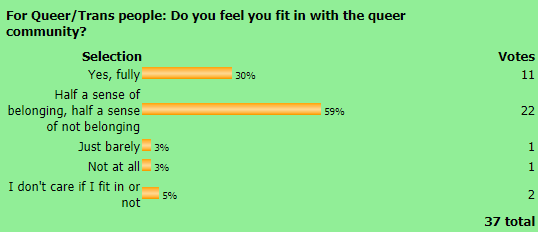
This poll was run on tumblr between June 1 to the end of July 2018 (2 months)
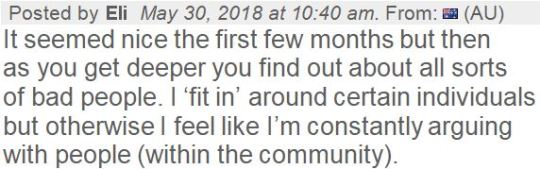
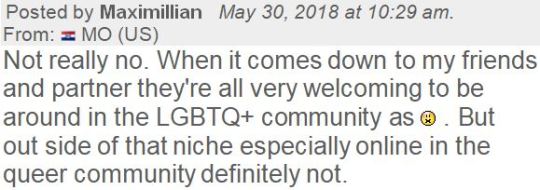
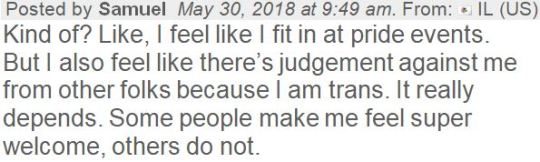
As you can see, the results show that not everyone feels they fit into the queer community. As someone pointed out in the comments, it’s very hard to define “fitting in” because it really depends on what the queer community is like where you live, and how involved you are in it. It was just about how you personally feel, how comfortable you feel in the community.
If there is even ONE person who doesn’t feel they fit in due to judgement, it should be something that leaders of the community think about, asking WHY and what can be done to make things more inclusive, instead of being passive about it.
(to those who wrote comments 1, 2 and 3: I know so much what you’re talking about.)
THANK YOU VERY MUCH to all those who participated in this poll!! Thank you also to those who left comments!!
Sorry, I can’t answer these kind of questions as they are very broad, and the main focus of this blog is not law. I can only answer those kind of questions when it’s narrowed down to just one country or so, and typically by looking up a government website. So I suggest you do that. It may not be made clear in the outlines you find, because sometimes you have to read between the lines to find out what is allowed and what is not allowed.
If you are unsure, the best thing to do is to send an email to an official government site asking them the question.
Also try the following link. It might be a good starting point for you to research this (see the chart at the bottom of the page):
I just watched this movie today (went to see something else with a friend but missed that one so we ended up watching this instead. Wasn’t sure I’d like it at first but I really enjoyed it in the end).
Here’s a description from an article online:
Film Title: “Montana” Description: A young woman returns to her hometown following the death of her grandfather, and begins an affair with a married teacher in the debut feature from Israeli filmmaker Limor Shmila. Powerful and intimate, she must confront secrets of her past as she tours the town of her youth. A TIFF world premiere.
….
Also, WARNING: It’s got some dark themes in the background (sexual abuse) but it’s not shown onscreen and the story is not all dark & gloomy. It’s got an overall empowering feel to it.
Here are some of the reasons I liked this movie:
-It has deeper storytelling elements that make for a stronger story overall… (e.g. not all questions are answered, there is ambiguity and realism, the characters are complex, their interactions/dialogue is natural and shows character)
-The filmmaker, who was there in the theater to answer questions, mentioned that one of the things the film is about is silences, and that when she came out to her extended family, they stopped talking to her… there was a silence around her identity. She said she wanted to show them and others in that culture that there are worse things than being lesbian… that due to silences, other things go unnoticed too (like actual abuse, which also happens right within the same society)
-The filmmaker (who is also queer) said that she also wanted to make a movie/story which focused on other aspects of a life than just being about “coming out”, since so many stories out there already cover this topic.
-The filmmaker (who had also experienced abuse) wanted to make a story where the character who had been abused did not act like a victim, since she personally does not see herself as a victim either.
-It shows queerness as being just one part of someone’s life/identity. There’s more to that person.
-It’s also a representation of queerness or queer experience in a non-Western culture.
-It was just a very boldly written story that felt very authentic, and worth watching for anyone who likes stories that not only touch upon LGBT experiences, but are also well crafted and nuanced (it had some great humorous moments too :).
-Hot/cute lesbian sex scenes/kissing that were beautifully filmed
I always thought of the Trump presidency as the last death throe of a dying system… so this is not surprising to me. There’s something called the ‘dustbin of history’, it’s where old ideas and those who represent repressive beliefs belong. Sooner or later.
I don’t know about Politics, but there are still occupational fields in which TALENT and DISCIPLINE means more than empty air.. in which, you know, QUALIFICATIONS actually matter.
The only thing I ever have to say to this scum is that he should go back to reality tv because that’s all he’s good at, and even in that he’s less than third rate.
My favourite part of that entire article was this bit:
‘Judge Kollar-Kotelly wrote in hers last October that transgender people are a “discernible class” who “have suffered, and continue to suffer, severe persecution and discrimination” but display “exemplary military service” regardless.’
As long as they are within the topics discussed, you are welcome to start a discussion or share from your own life anytime.
Subjects should fall somewhere into these categories: LGBT, consanguinamory, cousin relationships (straight or queer), being an ally, confessions, venting, educational materials, ads for documentary productions/casting calls, fiction, book or film recommendations/reviews, anything along these lines that you want to share…
The more others contribute, the more we can all learn, and I love to hear other people’s voices on this blog.
If you want to share a relationship story, read the post Here.
If you have a question you’d rather ask in private, or something that doesn’t fall into the above categories, feel free to message me and I’ll answer in private.
I was searching Google one day and found this website that offers a counseling service that is free. There are volunteers on there who play the role of ‘Listeners’. Some of these people are in training to become psychologists or therapists. I saw there’s also a section for LGBT-specific issues. It would be great for someone who doesn’t want to talk over the phone or meet a therapist in person or if you can’t afford to pay for therapy.
It’s called 7cups and this is the site:www.7cups.com
You just make a free account and go from there. The person you talk to might not be able to talk to you forever, but as long as they are on there, you can contact them on different days. If you find someone you click with, it could help offer a distraction in tough times.
I would recommend it to LGBT people. Paid therapists are also available through the site, but the ‘Listeners’ option is free.
All Hearts United – Therapy (requires payment)
This second service is another option for anyone needing therapy, but it’s also good for those who want to talk about Consanguinamory with a non-judgmental professional therapist. I describe it more Here.
This therapist can also be reached at THeart@AllHeartsUnited.org
Just sharing this info for anyone who might need it because mental health is important.
Generally, I find it very
hard to read about any religion without feeling anger; just idea that while
minorities are struggling every day to live authentically and with dignity, a
bunch of privileged people are sitting around discussing who gets to be the
final authority on morality.
Even in the distant past of
human history, it seems that sexually non-conforming people were reduced to
that one part of their identity—as though they were all about sex—with no other
dimensions to them.
The article “Homosexuality and Theravada Buddhism,”written
by A. L. De Silva, exposes some of the major inconsistencies in social
attitudes towards this subject from religion to religion.
Compared with
religions like Christianity, Buddhism seems to take a far less intrusive approach to
morality, encouraging people to refrain from judging others based on their
actions, and to use reason instead of personal biases to determine whether or
not an action is harmful. De Silva writes, Buddhism is an “ethics based upon
reason and compassion rather than tradition, superstitions and taboo.”
Buddhism teaches that the knowledge we gain on earth (a combination of “revelation”, “tradition”,
“scriptures”, and even our life experience) cannot give us the authority to
decide what is right or wrong.
It offers an interesting perspective by respecting autonomy
while at the same time defining some basic guiding principles for ethics. There
is acknowledgement of the unknown so that no principle is inflexible, but most
importantly, it does not grant society license to punish an individual for not
conforming. This mode of thinking gives people the chance to choose their own
paths, explore themselves, and find empowerment as a minority. It embodies the
“Live and Let Live” spirit.
Buddhist values provide a strong basis on which to introduce the LGBTQ cause. The author
acknowledges this in his analysis of the core teachings:
“All the principles we would use
to evaluate a heterosexual relationship we would also use to evaluate a
homosexual one. In Buddhism we could say that it is not the object of one’s
sexual desire that determines whether a sexual act is unskillful or not, but
rather the quality of the emotions and intentions involved.”
Since Buddhism encourages
introspection into the self and meditation, I always wondered whether
meditation brought the Buddha some kind of advanced knowledge that other
religions lack, concerning the true diversity of human experience… if so, it would explain (from a spiritual standpoint) why Buddhist teachings are not as strict/limited in their definitions of “right” or “wrong” as other religions are.






 rainbowamory