My question to cousinfacts tumblr about Beauty and the Beast

rainbowamory asked: Hi, I was wondering, in which version of the Beauty and the Beast story do they turn out to be cousins? I tried looking for the original but the endings of the ones I read don’t have that… And I couldn’t see any hints either, like maybe his mother being her aunt or his dad being her uncle. Maybe I overlooked it, I don’t know. So I was wondering which is the original? Which one has that ending? I’d really like to know :)Thanks

cousinfacts:

Hey, rainbowamory!

In the first written version of “Beauty and the Beast”, Beauty and the Beast turn out to be double first cousins, their fathers being kings and brothers, and their mothers fairies and sisters.

This version was published in 1740 by Gabrielle-Suzanne Barbot de Villeneuve, under the title, La Jeune Américaine et les contes marins.

Published in 1740, this really is the tale as old as time! Hope this helps!

Wow, that is interesting!! Now if only I can find that version in English translation… Thank you for the answer, cousinfacts!!

Loved For Who You Are – Our Beautiful Brokeness

youarelovedforyou:

What would life be like if none of us hid our emotional scars from each other? If when we looked at each other, we didn’t see people who had been broken (and therefore deserve our scorn, shame, or pity.) What would happen if all we saw was the whole, made more beautiful by their golden scars?

Loved For Who You Are – Our Beautiful Brokeness

Bisexuality

fuckyeahbiguys:

unbitled:

Ten Things To Think Really Carefully About Before Saying When Someone Tells You They Are Bisexual

Congratulations! Your friend/family member/colleague just came out to you as bi! *

That’s awesome—you’re obviously a person they trust and value, one they expect to treat them with care and respect in responding to this information, which in some contexts can cause people to lose their jobs and income and health insurance, or be at risk of physical and/or emotional violence, or be cut off from other friends and family and faith and community members. You must be incredibly great for them to put themselves at such risk with you.

There are a lot of painful stereotypes and myths out there about bisexuals, and most people who are coming out as bi have heard them long before coming out, so they know that with a lot of other people they’re going to get the proverbial “whole lotta ugly from a never-ending parade of stupid.” But not you.

They’re cool with you, and know, or at least hope, you’ll be cool with them.

You, um, don’t want to screw this up, right?

Of course not. You’re a good doobie. You wanna be down with the Bis as a Fierce Ally. Whether you identify as straight, gay, lesbian, pan, omni, asexual, or some other orientation, whether you’re cisgender or trans* or genderfluid/queer, you want to show you are worthy of this bisexual person’s trust in you.

So, if you’re thinking of saying one of the following phrases, or something close to one of them**, you might want to pause, take a breath, consider the context, think how you’d feel hearing it if the roles were reversed, and maybe, just maybe, say something else.

Or just give a hug. Hugs are almost always good responses. Sometimes they’re the best ones.

*While some of what’s on here would apply in the situation where a boyfriend, girlfriend, spouse, or other partner has just come out to you as bi, those are obviously different situations and probably deserve their own list, since your romantic and/or sexual relationship to that person may be directly involved. This list is really for those relationships that are only familial, professional, and platonic.

** Every single phrase here, or something very close to it, has been said to me or to bi friends during their coming out processes, by people they regarded as close, trustworthy friends, family members, or colleagues.

10. Why are you telling me? I don’t care who you sleep with or what you do in your bedroom or private life. It’s no one’s business/it doesn’t matter that you’re bisexual.

Easy there, Privacy Patty: they’re telling you because it does matter, to them, that people know—or at least that you know—who they are as a whole person; don’t go confusing that with what they do, or don’t do, in their personal sex life. A lot of non-bi people try to over-sexualize bisexuality this way by making statements suggesting it’s all, always, and only about sexual activity, rather than about sexual orientation. If you’re straight or gay, think about how you’d feel if someone said something so important to who you are as a person was unimportant or no one’s business.

9. Oh, everyone’s a little bit bisexual. (Translation: Oh, I don’t think anyone’s really bisexual.)

Good for you, you know your Kinsey Scale; here’s your gold star. Now: shut up.

Please don’t ever, ever let this first phrase pass your lips in earshot of a bi person, particularly one who’s coming out to you. Because it actually, logically and emotionally, means the second phrase. If everyone’s “bisexual” no one is. And this person is telling you, usually after a long and sometimes painful process of figuring shit out, that they are. Please don’t let your response invalidate the very identity they’re fighting to claim and be proud of. Bisexuals exist. Deal with it. And deal with us with respect, not suspicion about our existence.

8. What happened to make you this way? When did you decide? How do you really know you’re bi if you haven’t been with w amount of x gender(s) y number of times and performed z sexual activities?

Life. Same as you. They didn’t. Same as you. (They might be able to talk about when they first knew, and might want to, and if you’re gay or lesbian you might be able to identify with that experience, so go ahead and ask that.) Sexuality isn’t a formula or a certification course: you don’t solve it with the right integers, nor do you earn or achieve it with the right prerequisites or courses. It just: is. Just like your sexuality, their bisexuality isn’t dependent upon what they’ve done with whom, how much, how often, or in what variations. You’re smart. You can do this. This isn’t that tough: just think of your own experience and analogize.

7. So, do you sleep with both men and women and others and how does that work? So you’re non-monogamous? So, you’re monogamous anyway?

Bisexuality doesn’t equal non-monogamy, ethical or otherwise. Bisexuality doesn’t equal monogamy, coerced or otherwise. Just like every other sexuality. People’s individual relationship statuses are informed by, but not determined by, their sexuality, just like yours is. Do we assume all straight people are non-monogamous? (Statistics would suggest most actually are, over their lifetimes, but “most” isn’t “all.”)  Or that all lesbians are monogamous? Why? Don’t ask these questions unless you’re a close enough friend to be in a conversation about relationship issues, rather than sexuality itself. Even then think really carefully about it: the coming out moment probably isn’t the time, unless the bi person coming out to you invites the discussion. And be prepared to discuss your own relationship decisions, if so.

6. What STDs do you have?

Show your papers first, idiot. And it’s “STIs” these days, for “Sexually Transmitted Infections,” and out bisexuals are no more intrinsically at risk for contracting or transmitting them than anyone else. (Closeted people are.)

5. So, it’s just like a physical thing, right?

Yes. Just like your sexual orientation. Oh, wait…what’s that? Fact is: bisexuals feel a whole host of different ways about their sexual/romantic/emotional attractions to people: just like people of other orientations do. These things can even shift over time, from person to person, from relationship to relationship, and within relationships. Just like everyone else. If you’re gay, are you attracted to all men equally? Sexually and emotionally? If you’re straight, do you feel the same exact way about the hot model on the magazine cover as you do about your gorgeous spouse? If you’re a lesbian, have you had a crush on someone you wouldn’t want to actually be in a relationship with, or even have sex with? Yeah? Good, then. You’ve passed Human Sexuality 101, and need no additional knowledge to understand the nature of bisexual attractions.

4. That’s great, but being bisexual isn’t nearly as hard as being X or Y.

Don’t. Just don’t play the Oppression Olympics. No one wins. There’s too much that divides all of us already from our common humanity; engaging in round after round of “Who’s suffered more?” does nothing to alleviate anyone’s suffering or bring us any closer together. And it’s exactly what those who enjoy our suffering want and expect us to do. Knock it off.

3. I can’t believe you’re reinforcing the gender binary.

History check: you know who was on the front lines at Stonewall? Bisexuals and trans* people. Etymology check: do you know what the Latin route of “bi” really means in “bisexual” as bisexuals themselves have defined it? Two, as in “one’s own and other genders.” Note the plural.

(Did you also know that not all lesbians come from a tiny Greek island? And that not all gays are happy and carefree? Words change meaning. Bis are here, we’re queer, and we’ve been *trans-inclusive and *trans-friendly since before most people making the *transphobic accusations against us now were born.)

Definition check: Bisexuality means having the capacity to be sexually, romantically, and/or emotionally attracted to members of one’s own and other genders, not necessarily in the same way, not necessarily at the same time, and not necessarily to the same degree. Nothing in there about reinforcing gender binarism or being trans*phobic. (Refer to Number 4 for another take on why it’s important to drive the stake through the heart of this emerging stereotype about bisexuals.)

2. Who have you slept with? Who else is bi?

Seriously? SMH. They maybe should drop you as a trustworthy friend or stay away from you as a family member or colleague if your response to their coming out is to ask for a sexual dossier and “dirt” on other people.

1. You’re still my friend. I don’t care what you are. You could be blue, purple, or green. I love you no matter what.

This one’s tough, because it’s so common, and so understandable. You want to be supportive, so you come out with something like this. But please refer back to Number 10 and realize that this is just a kinder, less blunt version of it, at best.

And, at worst, it equates bisexuality with something to be ashamed of, something that has to be forgiven or overlooked.

When you tell someone, “I don’t care what you are, I love you anyway!” you’re telling them two things: 1. You’re not listening: they want you to love them as that thing. That’s why they’re telling you. That’s who and what they are, and they want you to care about it. Because they do; 2. What they are is something they should feel awkward over, and that you’re rising above. They don’t want you to. They want to be themselves with you, and they’re not apologizing for it—so don’t forgive them.

Hope that helps you navigate your way through these very important conversations, BiAllies and Would-be Bi Allies! Questions and comments welcome. Do you find these useful if you imagine someone coming out to you? If you’ve come out to someone, do you wish they’d read something like this first?

This. All of this.

What Type of Lesbian Are You? (Does it Matter?)

image

(Image from: LGBT Presentation by Janea Hubbard)

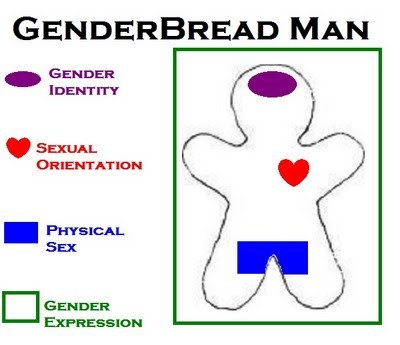
If you’ve been out in the gay community, you may have encountered some of these labels by now: Femme, Lipstick Lesbian – Butch, Stone Butch, Stud – and the many in-betweens (Chapstick, Boi, Soft Butch, Androgynous, Switch, Stem, Futch). It might be necessary to leave some blanks in case any more varieties spring up in the future of the lesbian crop: ______, ______, ______

What type of lesbian are you? Have you ever thought about it? Do you fit into any of the above mentioned categories, or are you a potential filler for one of the blanks? And most importantly,

Does it matter?

Life being a journey, it can take years and many experiences to develop an full understanding of one’s self. A person can be old and still discovering things about themselves – things they might’ve denied in their youth, or completely new facets of identity that only happened to appear in that specific time in their lives.

Some hold the attitude that there’s no rush to define yourself in any fixed way. And that can be very liberating, if in the meantime you are not misleading someone else or letting once-in-a-lifetime opportunities slip past you.

But there can also be a strong pressure from within the community to define yourself, as a preliminary requirement for becoming a recognized member of that community.

In either option there is something to lose. If you rush to define your identity according to strictly defined categories, you risk submerging your real self in order to get stuck playing yet another socially constructed ‘role’, as if it wasn’t hard enough to escape or redefine your originally assigned (straight, cis) role in the coming out process. Yet if you don’t attempt to label yourself even loosely, you might involuntarily be making it difficult for potential partners to seek you out.

Dating is difficult enough in a minority. Divisions according to ‘types’ can only make it moreso. So what do you do if you are unsure? Or if you feel you honestly don’t belong to any of the ready-made categories. Do you put on the label that comes closest to reflecting who you are and hope for the best? Or do you insist on living without a label, knowing that you may be overlooked by those on the lookout for very specific signs in their search for a partner?

Is there a solution? Maybe not an easy one, but it seems the best option would be the one with the least amount of consequences attached to it.

As long as you’re honest with your partner, there should be nothing wrong with taking your time in figuring out your ‘type’. And if nothing suits you perfectly, why not just be yourself? If there are others like you, a whole new category may form around you and them and you wouldn’t have to feel so alone. Just because there are already fixed labels out there, doesn’t mean the Label Maker is out of service. You can always carve out a niche for yourself where you and others like you don’t have to try too hard to belong.

And if you can’t find ‘others like you’ willing to take on a new label together, the best thing to do might be to remind yourself that each person is desirable to someone. No single ‘type’ can seduce the entire community. As long as what you seek is someone (monogamous) or a some people (polyamorous) to like you for you then it may be more beneficial and less painful in the long-term to go without a label.

Because if you do put on a label without feeling fully sure, and you begin to date, you and your partner may or may not be on the same page. This is where life would get complicated. If you tell them you’re one thing and they expect you to stay that way, you could get stuck playing a part again, and find yourself in a place where experimenting with your gender expression can leave the other person feeling disappointed or uncomfortable. e.g. if you say to someone that you’re a soft butch and a few months or years into the relationship you tell them you are actually trans and want to transition, some lesbians and bi girls can be ok with it, others won’t.

There’s nothing you could do if you just realized it with time. However, sometimes a good indication that things may change is that you feel unsure about taking on a label in the start – or not fully comfortable with the labels others place on you. If this is the case, it’s best not to take on a label at all, or at least to delay until you’re sure. This way you leave yourself space to grow, and anyone you date is more likely to accept that your gender expression is not a fixed one – or that you may be one of the blanks in the making.

Yea, this approach might take more patience, be a little more of a lonely road to take. But in the long run, it might be the least risky and the least likely to leave you heartbroken.

Everyone is desirable to someone. By denying your true self and comfort to accommodate someone else’s tastes, you might be making yourself less visible to those that would find you attractive exactly for who you are.

For your amusement, have a look at this page to see the different types of lesbians people have identified over the years. A glance at the comments should show that although there seems to be such an big emphasis placed on taking on a label in the LGBTQ community, many lesbians in real life are unsure of which one describes them best, or feel that more than one label applies to them.

Another option is that you can always take an existing label with its accompanying definitions and add your own dimensions to it. (e.g. be a long-haired Butch instead of a short haired one) Just like not all girls are straight, and not all gay girls look the same, not all categories will contain people that act the exact same way or agree to a single definition of what it means to be Butch or Femme or anything in between. To see this all you’d have to do is pick out a bunch of people from a single ‘type’ and compare them to each other – individual for individual. Are they all the same to you?

Re-blog from thefinalmanifesto’s tumblr (about abuse vs consent)

thefinalmanifesto:

I’ve noticed something recently. I have several followers who have been sexually abused by family members. It’s gotten me thinking, and there’s something I want to say:

Thank you.

I know that some of the positions I espouse, and the things I post, can be challenging to people coming from those…

These are the best kind of allies, the kinds that don’t generalize, and who look outside their immediate experience to acknowledge that every case is different, every situation is unique. We do need to make a distinction between consent and non-consensual acts. Otherwise we’re punishing a whole group of innocent people for the crimes of another.

Read his full post here: https://thefinalmanifesto.tumblr.com/post/86461366806/i-have-something-to-say


Doesn’t make sense

Just something I wrote as part of my character’s file, to better understand him. Also, this is something I don’t get either, about how cousin love is viewed by some cultures as opposed to other consanguineous relationships:

S.C. fully acknowledges that his relationship with his cousin is an incestuous one. He would readily admit that. But he doesn’t see it as a crime or as a kink or a fetish – but rather, as just a fact, that they are related. He gets very confused when he sees that some people overlook cousin love as [consensual] incest and don’t define it as such… he feels half relieved he doesn’t have to deal with the stigma other couples may have but is also utterly confused about the exception. It doesn’t make any sense to him. It’s like people see cousins almost as not being related at all…

Why “So Who’s the Boy and Who’s the Girl?” Isn’t Offensive To Me

⬆-This video caught my eye cause I feel the same way. Actually if someone assumes there is no guy in my relationship that actually offends me more, because even though my relationship is outwardly lesbian, I don’t identify as a woman.

I think she explains the topic very well from several angles, but she left out just one thing: one reason this question may NOT be offensive to some people is because one of them identifies as genderqueer or trans. So although it may appear to be a regular lesbian relationship (woman + woman) on the surface (due to one of them not having transitioned yet or having feminine features), beneath that the couple may see each other very differently than how the world sees them (as a boy and a girl, boi + girl, genderqueer + cis, etc). And in that sense, they may be closer to feeling like or behaving like a straight couple than a gay one – even though outwardly they are seen as the same sex.

I know exactly how that feels. And there’s nothing wrong with it 🙂 I respect the fact that my girlfriend is a lesbian and she respects the fact that I don’t identify as a woman.