It was such a looooooong, painful journey to bring these two to life through ball-jointed dolls. And expensive as hell.
This was pure self-indulgence. But I needed this and I always dreamed of having my OTP / OCs as dolls.
Examples of my troubles include:
Buying several pairs of eyes for each to try out which ones look most like my characters, getting a person to paint her face to resin-match her body, getting her head custom-made by three different people in three different steps (e.g. 3D model to 3D print to faceup painting), putting on their anti-stain clothing, dying his wig (I failed twice with two other wigs before I got the color right) because I couldn’t find a wig that color for a good price anywhere… And then having a mini panic moment when I was trying to put his hands on all by myself while using my foot and a clean cloth to hold him in place… putting on his pants…. the list goes on.
I can’t believe I made it to the end with these two. lol
I still need to dress her in black and replace her wig with a black one (she came with a dark brown wig).
I think the dolls represent their late teens / early 20s how they would look.
[This is an old post from Tumblr, first posted in July 2014]
The definition of Prejudice is : “preconceived opinion that is not based on reason or actual experience.”
In this post, I am going to discuss my personal experiences with prejudice, and why I think it’s important for people to challenge the way they think about things, that is, if their opinions are hurtful to other people’s freedoms.
I used to be a very critical, judgmental person, who didn’t think twice about cringing along with the rest of them whenever I heard or saw something that was considered ‘taboo’ in society. This only changed when I realized that I was actually ‘one of them’ (potential target) and that I was in denial about it for the longest time because of the fear of being judged. My personal experience has proven to me that it is possible for people to overcome prejudices, even if they are surrounded by them every day from all directions.
How do you do it? You simply begin to think for yourself.
I am going to list here some lifelong prejudices I’ve carried around in my head from childhood to adolescence, and some into adulthood. Then I will go on to explain how I overcame them:
Prejudice #1: True love can only exist between two people, otherwise it’s not true love.
Prejudice #2: Same sex couples shouldn’t raise children, because it would be unfair to the kid, who would either never have a mom or never have a dad.
Prejudice #3: Consanguinamory of any kind is wrong, because you’re not supposed to do those things with family members. Family relations should be chaste at all times, like friends without benefits.
OK. That hurt to write… Because I no longer think that way, about any of it.
╰☆╮Let’s take #2 for instance. When I asked myself why I felt that way, I saw that it was because of how I’ve been raised. I never knew things like divorce or single-parenthood. In my culture the family is a very tight unit that cannot be broken once it has been made, no matter how dysfunctional it may become or how unhappy. Spouses are just resigned to stick it out till death. There’s no such thing as second chances, and divorce is looked down upon… But as I grew up, I got to know people that came from different family structures, and saw that they were no less stable than I was. Yea, there might’ve been a void in their hearts due to the absence of one of their parents, but some of the nicest, most intelligent people I’ve met have come from what would be thought of as ‘broken families.’ It really opened my eyes to the possibility that a kid can grow up healthy and happy outside of a traditional family arrangement.
The family of a same-sex couple would be no different. In the end it’s not about having one of each gender to raise you… it’s more important to be loved by whoever raises you–whether two people, one person, or a group of people. I suspect that those children whose parents were absent weren’t sad because they didn’t have ‘one of each gender’ as a parent… they were sad because they felt unloved by one or the other. Just because you have one male and one female parent, doesn’t automatically mean both will cherish you equally or be responsible or stable. Gender has nothing to do with the characteristics that make a great parent. Those characteristics (reliability, knowledge, understanding, emotional stability, affection, selflessness, etc) can exist independent of sex and gender. Therefore, a same-sex couple has just as good a chance at raising a healthy family as any two people of the opposite sex.
╰☆╮Now, for #3. This one is a little strange… I’m not sure at which age I developed this opinion. I think it sort of grew on me overtime. I remember hearing that brothers and sisters get separate rooms when they hit a certain age. The explanation I always got for this was that they were growing children, so they needed their own spaces. Yet, it was never a big deal for siblings of the same sex to share a room well into their teens.
It was only later, when I learned that many people first experiment within the family than would like to admit, did I begin to see that arrangement in a different light.
Maybe it was a way to suppress something that might have naturally occurred between siblings without social conditioning. So no matter how much people try to act like it’s ‘unnatural,’ they seem to know deep down that it is natural. They create stigma to discourage young people from acting on whatever tendencies they may have growing up, without letting them think for a second that it might be natural to have such inclinations or thoughts. This creates guilt, fear, and self-censoring from a young age–which these same kids then pass onto their own.
When I was growing up, I didn’t have to wonder at these changes since I didn’t have a sibling of the opposite sex, so my arrangements were different. Yet even for me, the self-censorship was hard to challenge. So what finally changed my mind? I might go more into this in another blog, but simply put, it was a story. I used to roleplay with someone while growing up and one of my main characters was a boy who fell in love with his cousin (the other player’s made-up character). It wasn’t meant to happen. I was about 14 when this twist happened in the story. And even back then (in the start), I had the vague, unsupported opinion that it was wrong… Yet their relationship (though fictional) was the most beautiful one to me in the whole story. The boy continued to love her, so deeply that I was gradually persuaded to think differently about consanguinamory altogether. I don’t know if someone might laugh at that–if they might say that fiction is not reality. But I believe that you’d have to be the worst kind of hypocrite to accept something (related to human rights) in fiction while denying it reality. That is nothing less than exploiting a serious subject for entertainment, while ignoring real people’s real trials in the world.
I believe in the power of Fiction because it compelled me to educate myself more about the reality of these kinds of love, and support others who are like my character in real life. Which is why I’m here now.
╰☆╮Addressing prejudice #1: Unlike the above two, this one was largely a personal opinion. I didn’t realize that I was projecting my own idea of what makes a relationship onto people whose minds and hearts worked differently from mine. There was someone in a discussion group I attended once, a guy who said he was polyamorous. He was trying to explain what that meant, saying that he had several lovers and that he loved them all in different ways; that he tried to give them all as much of himself as he could, and that he always felt he had more love left over to give to another person. I couldn’t for the life of me wrap my head around this… because I’ve always believed that if you needed more than one person it meant you hadn’t yet found your Soul Mate.
But now, having been through my own life struggles and developed as a person, I see that I had misunderstood him. Polyamory is not for me because I am a possessive, monogamous person who is apt to jealousy. But polyamorous people don’t feel this way. I learned that they are actually more than happy sharing their lovers with new poly people, and that they’re not really plagued by any feelings of jealousy. Most importantly, they are always honest with each other, so there’s no deception going on, no cheating. Their relationships are mutually agreed upon, and there are no secrets or lies between them.
Now whenever I get disturbed at the thought of sharing the person I love, I remind myself it’s because I am monogamous. It doesn’t work for me, but that doesn’t mean it can’t work for someone else.
☾Final Thoughts
Why was I so full of judgment?
For the same reasons so many others still are – Social conditioning and sheer ignorance. And.. fear of not fitting in.
What did I learn about overcoming prejudices?
I learned that overcoming prejudices didn’t invalidate my identity in any way. It just made me a more open-minded person. It freed me from the maze of inner-contradictions, from the tensions of trying to hold onto beliefs that weren’t really mine to begin with, beliefs that were put into my head from the outside world before I learned to think for myself.
I learned that I don’t have to be polyamorous to support polyamorous rights, that I don’t have to be a gay parent to empathize with and support same-sex families, that the freedom to have romantic consanguineous relations is as much a human right as anything else (because blood is just another physical detail; like skin tone, age, gender or sex).
I have come to believe that if you want to change the way the rest of the world works, you have to begin with yourself first. If you don’t work on identifying and overcoming your own prejudices, how can you expect other’s to do the same for you? Maybe right now you are happy being a conformist, but someday you may find that you desire something that is considered ‘unconventional, taboo, unnatural’ by the rest of society. You shouldn’t have to wait till that day to make a path for other people… a path that you yourself (or your children) will also be able to use, if you ever have the need.
Anonymous asked: hi, i was wondering if there’s anything wrong with dating your 4th cousin? And how to deal with family reactions?
Hey,
There is nothing inherently wrong about dating or being in love with a relative, as long as it’s fully consensual. In many places in the world, first cousins can marry. In even more places, 2nd cousins, 3rd cousins, 4th cousins, etc can marry.
I’m not the person to ask about more complicated things like advice on how to deal with family reactions. I have made little suggestions before but there are things others would be better suited to help you with.
So I would recommend you visit some of these sites where you can find communities of people that would be more knowledgeable about this topic:
This was a submission from Delanie, a casting call for a cousin couples documentary. There have been similar ones before but the difference with this one is that you can submit your story ANONYMOUSLY. That would make a BIG difference for someone who may have wanted to educate the public about their life while keeping their privacy… so have a look at the details if you are interested.
Delanie’s Message:
Hi everyone!
My name’s Delanie and I’m the executive producer of a documentary filming in Los Angeles this spring about romantic cousin relationships in the United States. This project is being made to bring positive attention to cousin couples and hopefully improve the public perception on this topic. My mother dated her cousin, so this is a personal passion project for me. I am looking for dating or married cousin couples, children of cousin couples, or friends/family of cousin couples that would like to contribute their stories ANONYMOUSLY. I understand that this is a sensitive topic and most people do not want to be on camera discussing it. If your story is chosen for the documentary, we will cast actors to portray you and share your experience. We will not use your real name(s) and will change any details you wish in order to protect your identity.
If you are interested in being an anonymous contributor to the project, please email me at delaniefischer@gmail.com. You will be provided with a questionnaire to fill out, and I’ll be happy to answer any questions you may have.
Another one! I can’t wait to see the results of these things.
Just sharing on my blog for anyone that might be interested in participating. There may be ways to participate that doesn’t involve appearing on film (you’d need to contact them and ask them). All details are in the above link. 🙂
I just wanted to explain the reason I focus on reproduction a lot on this blog. It’s not because I am trying to push it on you. It’s because it’s the area where most stigma arises from, the area most people don’t know much about. Because of ignorance surrounding the topic of reproduction, straight cousin couples have the most amount of stigma placed on them. So that’s why I like to address it from that angle.
Reproduction is definitely not for everyone, for various reasons. But I hope that the information I link to and share is of use to you, whether you are just trying to learn more, or in the process of deciding if you want to have a family.
I haven’t come across same-sex cousin couples info yet but if I do I will post here. Please feel welcome to submit an Ask or Share a Story if you are with your same-sex cousin.
I think I’ve mentioned the reddit page before but since then I’ve not been there much, mostly because the discussions there are often fetish-based, and that is not what my blog is about.
However, today I went there to see if I could post something about this blog, when I came across a post that caught my eye… At first it seemed extremely disheartening to read the original poster’s experience. It stirred up some negative feelings in my head… coming from the perspective by which I am used to looking at this type of relationship.
But as I read some of the responses, as well as how the original poster’s reflections evolved as they attempted to understand and process the new information they were getting, I found it to be an interesting and balanced post in many ways.
It helped put some things into perspective for me too, like why the child of a cousin couple might have a hard time accepting their family’s reality. Such a large part of it has to do with the stigma society creates… which wouldn’t exist if more people actually examined this subject up close, with the ability to distinguish between personal distaste vs. facts vs. ideas that are taught to us from a young age rather than occurring naturally in us.
And in the discussion also, the poster mentions the role media representations played in their overall reaction, self-image, and struggle to accept things.
It is an important post to read, no matter from which angle you are coming at this topic (as the couple or the child of such a couple).
The poster also mentions that her father felt he had made a mistake (as in the pregnancy had been unintended). That revelation also had a negative impact on her process of self-acceptance. I just want say that this is why on this blog I am always referring to relationships that are not only consensual but built on deep mutual love. Because the more genuine the love between the couple is the less likely they are to regret their decisions.. and the less likely their kids are to feel more pain than others’ ignorance already creates for them.
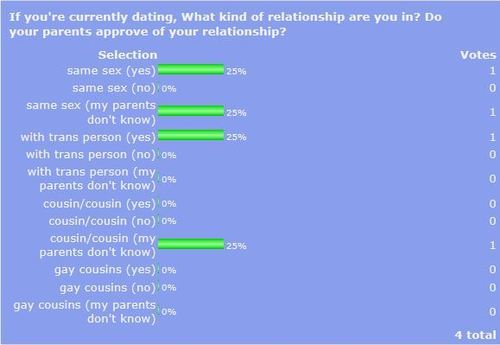
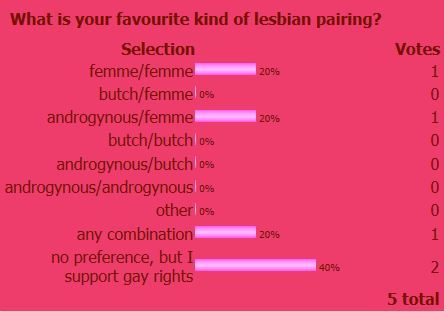
So, this isn’t many votes but that’s cause I don’t have like a huge amount of followers or anything. I just find it very interesting to see what kind of people follow my blog. So thank you guys for voting!! ^_^
Intro: I am posting here the results of an interview I conducted by e-mail with someone who is a descendent of cousin marriage. This is for the benefit of those who might find this information helpful in seeing what kind of factors they may need to consider if/when deciding to make a family of their own.
Any opinions or facts expressed here should be taken as the experience of one individual. The opinions of others with similar family lineages may vary based on where they grew up, cultural background, family dynamics, personal world-view, and the varying levels of stigma they may be exposed to. It should also be noted that the genetics risks for a single generation cousin marriage differs from the risks in families with several intermarriages in them. Social conditions are important to consider when making a family, but incorporating genetic counseling into any decision-making process is the best way to have a more complete idea of what you can expect in the future.
INTERVIEW:
1. To begin with, what is your age? Gender? And sexual orientation?
Between 49 and 60, male, straight.
2. Which couple in your direct lineage is related by blood to their spouse? If there is more than one, which couples are related by blood? To what degree are they related? (e.g. first cousins, second cousins, etc)
My grandparents were 1st cousins once removed. My grandfather used to joke about their relationship when my cousins and I were growing up. He used to say that my grandmother was more Smith (not our actual surname) than he was, because both her grandfathers were Smiths, while only one of his grandfathers was a Smith. It’s possible they were also related another way, but my research into our family ‘tree’ isn’t very far along. I frequently joke with my cousins and other friends and family that our family tree is more like a family ‘wreath’. 🙂
3. How old were you when you first found out about the intermarriage or intermarriages? How did you find out? (e.g. did someone tell you directly or did you figure it out by accident?)
I was a child, but I didn’t really understand the significance until I was an adult. It was not a secret, everyone in the family knew. It wasn’t just my family, most of the other families in the area had intermarried as well due to the smallness of the gene pool. In fact, everyone in that area is interrelated. For example, one cousin (I’ll call her ‘Janet’) is my 1st cousin once removed through her father (i.e. she and my father are first cousins), and she’s my 5th cousin through her mother. I’m not sure if that’s the correct terminology for that relationship by the way. Her grandmother and I, we’re third cousins, if that helps. See? It gets confusing!
4. What was your initial reaction? Has that reaction changed over time or has it stayed the same?
Surprise was my initial reaction. But that just made their entire relationship seem more magical and special to me since they’d grown up together and knew each other their entire lives. I haven’t been surprised by it since I initially realized they were relatives.
5. Do any of your friends know about the cousin marriages in your family? How have they reacted?
Yes. I only have a few friends, but they all know. I tell them. I find it interesting and these days, seemingly, unusual. I’m actually proud of my family’s ‘closeness’. Mostly my friends express surprise. If they felt anything negative, they never mentioned it. I realized a long time ago that it’s not everyone’s bag-of-fun, so I always make sure they know that I don’t care what they think and they’re entitled to their opinion, but at the time it happened, it was QUITE common in most small communities, and they may have some similar marriages in their own background they just don’t know about. One of my best friends was my first cousin, so he really couldn’t say anything bad. 🙂
6. Do you experience social stigma from your friends or others in your family because of your lineage? If so, how do you deal with it?
Nope. Everyone knows all about it. See above. 🙂
7. Would you consider yourself to be physically and mentally healthy? Do you have any defects (mental or physical) that has been confirmed to be a result of the consanguinity of your ancestors?
I’m healthy, mostly, but I do have some inherited issues. I have degenerative disc disease. I have the spine of a 90 year old man. I became permanently disabled at the age of 42, the same age that my father became permanently disabled by the same condition. My grandfather also had the same condition. However, I think it’s just one of those things. None of my other male cousins (5 of them) have reported any of the same problems. Mentally, I’ve had issues, but, again, no one else in the family has ever reported any of the same issues as far as I know. Now, I did have an uncle who was developmentally disabled from birth. He died back in the 60s when he was in his mid 30s. I was told he never developed mentally past the age of 6 months.
Most of my mental issues stem from being sexually abused on and off for 11 years by one of my older male cousins. Yes, I’m an incest/sexual abuse survivor. I’ve been diagnosed with PTSD, manic-depression, etc. I’m actually sometimes amazed at how normal I am.
8. What would you say about your quality of life? (e.g. are you happy with life in general? does the stigma around cousin marriage affect you negatively in any way?)
Perfectly happy except for the back issues. I had a great career until I became disabled, I had an outstanding education. My family loves me. I feel pretty much blessed most of the time. I’ve never experienced any stigma. In fact it’s legal for first cousins to marry where I live, so grandma and grandpa’s marriage wasn’t even that close. As far as I can tell from my current knowledge! 😉
9. How do you relate to those cousin couples in your family? Do you get along with them? Do you feel there is a difference in the way they play their grandparent or parental roles in comparison to non-related grandparents or parents?
Everything’s cool. Everyone loved and respected my grandparents. The only time there was a problem was, recently, when two of my 1st cousins once-removed got married a couple of years ago. They were first cousins to each other and had the same last name. The reason most of the family disapproved was because they were both in the ‘trash’ branch of the family and the male cousin was like 20 years older than the female cousin. I actually had more of a problem with the fact that he’s a loser and she’s a loser and together they were a couple of losers. 🙂 They weren’t married long. Like a year, I think.
10. Does your lineage affect your dating life? (e.g. Do you feel it’s harder to find a partner who is accepting of your family history? Do you experience rejection from potential sexual partners based on your origins?)
The only problems I had in my dating life were caused by my own shyness and mistrust of women. I always tried to be honest and open about my family, so when talking about them, I always brought up the intermarriage. I’m proud of my family and would never try to hide the intermarriage. I haven’t had a lot of partners, because I tend to get involved fairly quickly if the other person is ‘into’ me. But, no one has ever said “I can’t be with you because some of your family members married each other.” I don’t think I would have stood for that any way.
11. What country or state do you come from? (if you want to share) Is there anything else you’d like to add about cousin marriage in general or about being a descendant of one or more cousin couples?
U.S. I’m going to be vague but you can probably figure out the state from vague hints in this email. It’s a state in the southeast part, and it was one of the original 13 colonies. We’re from the part of the state where the mountains are. 😉 I guess you COULD make jokes about inbred hillbillies and there’d be a *certain* amount of truth to that.
As I said, I’m pleased as punch to be a member of my family, I love almost all of my relatives (not THAT way though!) and I’m not at all ashamed.
12. What type of marriages were the cousin marriages in your family? (e.g. were they arranged? based on mutual desire and love? a marriage of convenience?)
All based on love, though I’ve heard my grandfather and grandmother’s marriage was a ‘shotgun’ wedding. Grandpa got grandma knocked up and had to do the ‘honorable thing’ and marry her. He didn’t deny he had been with her, but he had such a horrible childhood and, based on the behavior of his mother and sisters, he assumed all women were lying whores. Grandpa accused my grandma of trying to slip a ringer in on him and, apparently, claimed for years my oldest uncle was not his son. (Long story). He did love her, and she loved him with all her heart. They were married for over 60 years, and I never heard him treat her badly. Though I heard stories about when he was younger that curled my toes. Again, too long of a story!
13. Is there anything else you’d like to add about cousin marriage in general or about being a descendant of one or more cousin couples?
Not really. I just think you love who you love and you should be free to be with that person if you’re both consenting adults. Who really cares? It’s nobody’s bidness. 😉
Human beings took our animal need for palatable food … and turned it into chocolate souffles with salted caramel cream. We took our ability to co-operate as a social species … and turned it into craft circles and bowling leagues and the Metropolitan Museum of Art. We took our capacity to make and use tools … and turned it into the Apollo moon landing. We took our uniquely precise ability to communicate through language … and turned it into King Lear.
None of these things are necessary for survival and reproduction. That is exactly what makes them so splendid. When we take our basic evolutionary wiring and transform it into something far beyond any prosaic matters of survival and reproduction … that’s when humanity is at its best. That’s when we show ourselves to be capable of creating meaning and joy, for ourselves and for one another. That’s when we’re most uniquely human.
And the same is true for sex. Human beings have a deep, hard-wired urge to replicate our DNA, instilled in us by millions of years of evolution. And we’ve turned it into an intense and delightful form of communication, intimacy, creativity, community, personal expression, transcendence, joy, pleasure, and love. Regardless of whether any DNA gets replicated in the process.
Why should we see this as sinful? What makes this any different from chocolate souffles and King Lear?
Sadly, those who find our sexuality to be “sinful” also find our other creative endeavors to be sinful as well. Those who go after those of us who are LGBT are the first ones to ban books, boycott shows, etc.
Wow, that is so true… like that cousin marriage book that was on that library site, where they were asking whether or not it should be banned. That book contained FACTS around the topic rather than perpetuating more myths and misconceptions created by willfully blind cultural and religious prejudices. It really says something about a society when people try to control information itself from being put out there… anything that takes a neutral view of a subject that is considered taboo is often attacked by these same people because they know that accepting media or art that present these topics in a positive way is the start of examining it more closely in real life.
I also like what the quote was saying about sex. Something that I’ve noticed people do when making arguments against interbreeding and intermarriage is making this assumption that the couple should not be together because there are others out there that they can be with without taking as much of a reproductive risk. These arguments are misguided for two reasons: first, those making the comments are often speaking in ignorance, not knowing the actual facts behind the risks. Second, they fail to consider that the couple may be together for so much more than just the instinctual desire to reproduce… There’s so much more to a human relationship. Which means that those who make up the relationship are not exchangeable with just any random person in the population. They can be unique and irreplaceable to each other.
To say that certain couples (like a cousin couple for example) should break up because of reproductive risks is an insult to all mutual human relationships, because you are saying that it’s just that easy for people to let go since when it comes to sex all that matters is “replicating your DNA.”





 rainbowamory