I always thought of the Trump presidency as the last death throe of a dying system… so this is not surprising to me. There’s something called the ‘dustbin of history’, it’s where old ideas and those who represent repressive beliefs belong. Sooner or later.
I don’t know about Politics, but there are still occupational fields in which TALENT and DISCIPLINE means more than empty air.. in which, you know, QUALIFICATIONS actually matter.
The only thing I ever have to say to this scum is that he should go back to reality tv because that’s all he’s good at, and even in that he’s less than third rate.
My favourite part of that entire article was this bit:
‘Judge Kollar-Kotelly wrote in hers last October that transgender people are a “discernible class” who “have suffered, and continue to suffer, severe persecution and discrimination” but display “exemplary military service” regardless.’
As long as they are within the topics discussed, you are welcome to start a discussion or share from your own life anytime.
Subjects should fall somewhere into these categories: LGBT, consanguinamory, cousin relationships (straight or queer), being an ally, confessions, venting, educational materials, ads for documentary productions/casting calls, fiction, book or film recommendations/reviews, anything along these lines that you want to share…
The more others contribute, the more we can all learn, and I love to hear other people’s voices on this blog.
If you want to share a relationship story, read the post Here.
If you have a question you’d rather ask in private, or something that doesn’t fall into the above categories, feel free to message me and I’ll answer in private.
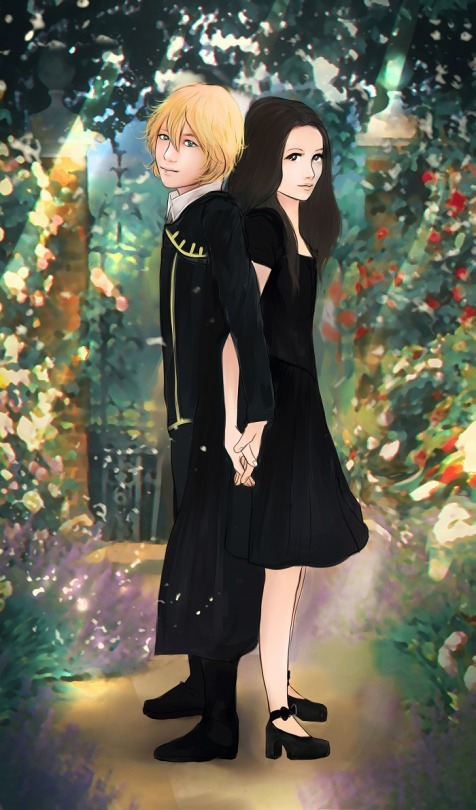
I has another review to make. 🙂 🙂 I commissioned Everybery to draw my characters. The guy draws insanely fast, so he was done in about a week. He was very nice in accommodating my little requests along the way. Good communication. He has a lot of diversity in his work so I felt comfortable going to him with my request. The amount of detail he puts into a drawing depends on the price you agree on.
What I Asked For:
My two characters standing in a pose, back to back, holding hands, with their faces turned outward. I noted that they should look 15 years old. The reason this one is different in some ways from the other artwork (other than the different style) is because I gave different reference pics for this one. I like trying out slightly different looks to play with aesthetics for how they’d look. I also asked for these outfits and for an abstract garden background. I sent him the link to the pics in my Dropbox–a good site to host images.
Meaning:
I didn’t exactly have a specific meaning in mind for this idea. It was just meant to be a cute pose. But looking at it afterwards, it made me imagine them being at a party (like maybe at his house) and a Photographer dude is walking around taking pictures of the guests. Maybe this photographer thought the two of them looked cute, hanging out together, and asked them to pose for a photo. They’d likely be dating at this point, since they’re on good terms here. lol
Just as the other drawing captures the tensions beneath their relationship, this one captures the innocence, a lighthearted moment.
…
Everybery sent me a full-resolution version of the final artwork, just like the other artist. The photo below is a resized, smaller version. It’s much prettier than Tumblr can show. I’m very very happy with it and would recommend the artist to anyone, especially to those with unconventional OCs.
Artist: Everybery
OCs belong to: me (rainbowamory)
See below for a little edit I did on my cell phone, using a part of the image.
I was searching Google one day and found this website that offers a counseling service that is free. There are volunteers on there who play the role of ‘Listeners’. Some of these people are in training to become psychologists or therapists. I saw there’s also a section for LGBT-specific issues. It would be great for someone who doesn’t want to talk over the phone or meet a therapist in person or if you can’t afford to pay for therapy.
It’s called 7cups and this is the site:www.7cups.com
You just make a free account and go from there. The person you talk to might not be able to talk to you forever, but as long as they are on there, you can contact them on different days. If you find someone you click with, it could help offer a distraction in tough times.
I would recommend it to LGBT people. Paid therapists are also available through the site, but the ‘Listeners’ option is free.
All Hearts United – Therapy (requires payment)
This second service is another option for anyone needing therapy, but it’s also good for those who want to talk about Consanguinamory with a non-judgmental professional therapist. I describe it more Here.
This therapist can also be reached at THeart@AllHeartsUnited.org
Just sharing this info for anyone who might need it because mental health is important.
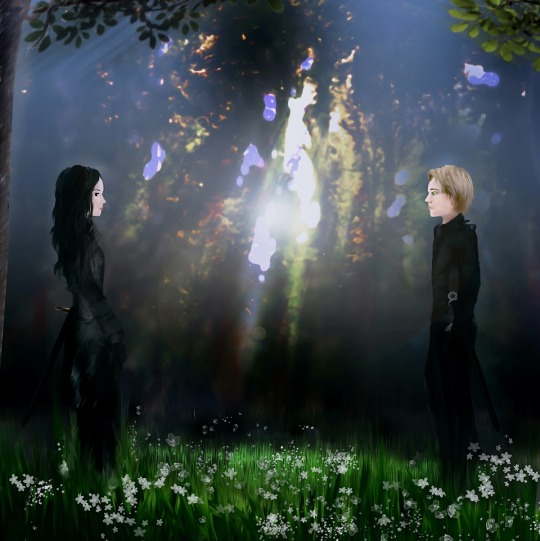
I commissioned her to draw my OCs. It took a couple of weeks but I am very happy with the result. She listened to my requests each step of the way. I gave her the reference pics (uploaded onto dropbox) and she worked with those.
What I asked for:
A scene in which my characters are staring at each other from opposite ends in a clearing, a forest setting, with dawn light streaming through the leaves and white flowers on the ground. I wanted them to be in black, close-fitted battle outfits, with their swords in scabbards (ages 15-16 years old).
Meaning:
It was meant to reflect the difficult part of their relationship, which actually is less about the blood relation and more about the fact that they’re on opposite sides of a conflict. They manage their relationship outside the war, but this scene was supposed to show them meeting, either before or after a battle. The clearing is like a quiet space and the white flowers were meant to represent peace – for this one moment.
kingloptr did a fantastic job capturing what I wanted and she was friendly. I would recommend her to anyone who wants an original artwork. The amount of detail depends on the price but you can make an offer and see what the artist can do.
Thank you again! ~ ❤
Artist: kingloptr
OCs belong to: me (rainbowamory)
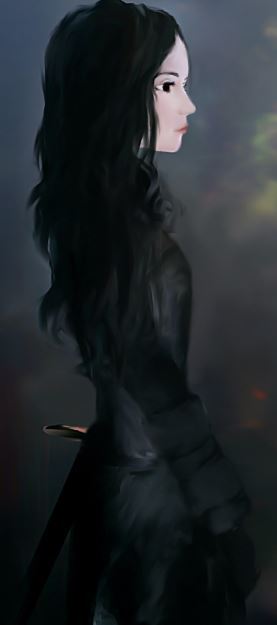
Click ‘read more’ to see close-up of the characters.
Your hatred towards white people makes mixed people self hating
Your jokes about white girls with thin lips/no curves makes black girls and mixed girls with those features feel insecure
You make mixed people and black people who don’t agree with you feel unwelcome in the black community
(by mixed people I mean those with white and black ancestry)
I’m a mixed person of black and white ancestry and while I can’t speak for all mixed people: what you wrote here is ignorant, misguided and frankly, embarrassing. Delete this post and then your entire blog if you genuinely think that black resentment towards whites (who have systematically oppressed and abused them) is at all responsible for my insecurities about my appearance or my status as a person of color.
So anyways, hatred towards white people hurts mixed people of white ancestry, especially white – passing mixed people. Ty, come again.
THANK YOU, itscoldinwonderland. I’ve experienced this same shit from a different racial background… so I know what you’re talking about here.
This is an essay I wrote for a grammar course, about the use of singular ‘They’, edited a bit:
My essay:
Any applied study of English
grammar would reveal that language comprises a constantly evolving set of
conventions. For this reason, language experts often find themselves warring
over the rules of grammar. These people typically fall into two main factions. Prescriptivistsaregrammarians
who recommend writers follow “long-established” rules, viewing any deviations
as “incorrect” usage; descriptivists, on the other hand,are linguistic experts who assert that
“a language is defined
by how its users speak and write it, and that language ‘authorities’
can only describe usages, not allow or disallow
them”. One example of a practice under dispute is the use
of they as a singular pronoun, with a
singular, indefinite antecedent. By examining the history of this usage, we can
begin to see how much a language is shaped by the people who use it, often to
the point of persuading even the most inflexible of prescriptivists to bend the
rules a little to reflect changing times.
Dennis Baron, a
professor of English and linguistics at the University of Illinois,
reveals through his research that people have been seeking a common gender pronoun
for more than two centuries. Some past suggestions included hi, le, hiser, and thon, but
none were universally accepted. Meanwhile, the use of they as a singular, common gender pronoun can be observed in the
works of many well-known writers, from Chaucer to Shakespeare. As Linguist and
writer, Jonathon Owen, points out in his
blog, the disagreements arose when prescriptivists began favouring the use of he as an all-inclusive, singular pronoun
during the eighteenth and nineteenth centuries. This was problematic because the
use of primarily masculine pronouns to refer to a common gender caused readers
to envision a male subject, even when the context did not specify gender. The
result was that many felt excluded—both women and gender non-conforming
individuals alike.
In his discussion of
the history of pronounson a podcast
by MPR
News, Professor Baron takes us back to the matter of
“correctness”. He notes that in earlier examples of written language, the
resistance to the use of they as a
singular pronoun had more to do with grammatical correctness and logic than
inclusivity. The
pronoun-antecedent
rule holds that a pronoun must agree with its antecedent in both number as well
as gender. Baron gives us the example
phrase:
Everyone loves his
mother.
The
issue with this phrase, as Baron explains it, is that although his (being singular) agrees in number
with its antecedent, everyone, it
fails to meet the gender-agreement part of the pronoun-antecedent rule, since everyone is an indefinite, singular
pronoun that could refer to either gender. By this rule, using singular they would not be any more correct, as
it would fail the number-agreement part of the pronoun-antecedent rule, they being plural while everyone is singular.
Modern day conversations place more
of an emphasis on the question of inclusivity as opposed to convention. The Merriam-Webster
dictionary recognizes that “Though singular they
is old, they as a non-binary pronoun
is new. [It is used] for a person whose gender is known, but who does not
identify as male or female”. Kristen Hare, a media journalist at
Poynter Institute, echoes this observation when
she speaks of print media. In 2014, the Wall
Street Journal began allowing the use of singular they to refer to contributors that did not identify with a specific
gender. Soon afterwards, the New York
Times and Washington Post followed.
More and more Universities and Colleges are also making changes to school
policies to include gender-neutral pronouns for students to choose from in
their registration processes. Data
collected indicates they as one of
the main choices made by gender non-conforming students.
John
Eastwood writes, in his Oxford Guide to
English Grammar, that in modern times the
use of he as a common gender pronoun
is “less common than it used to be.” Eastwood is of the opinion that singular they is “neater than [her or she]” and is common in informal
contexts.
Other
academics and grammarians have mixed views, however. Some still recommend using
the generic he or she coordinate with
singular, indefinite antecedents—or avoiding pronouns altogether. Dictionaries
such as the Canadian Oxford Dictionary
list the singular use of they as
being “disputed,” though popular, while the Merriam-Webster
dictionary lists it as a respectable secondary option to the old convention,
citing that it’s been used in
both literary and formal contexts alike.
Despite all the recent acceptance in the mainstream, authors Patricia T.
O’Conner and Stewart Kellerman feel that although singular they has a long history in usage, it still has a long way to go
before becoming universally accepted.
In
light of this history, we are left with a question of what to do while the
natural process of language evolution takes place. For the time being, when it
comes to singular they, choosing to
subscribe to the prescriptivist or descriptivist view appears to be a matter of
personal preference. As a student of literature, an aspiring writer, and
someone who identifies as a member of the trans community, I too share the
mixed feelings of many others. I used to think that the rejection of singular they was driven purely by transphobia. I
can see now that this assumption was largely the result of having grown up with
the modern usage and attitudes. I’ve learned that this fight
was always more about linguistics and the rules of grammar than intentional transphobia.
Although one does have to wonder whether things might’ve been different if non-binary
people came out back when these rules were being made…
While trans people may not
have been part of the picture back when more people were closeted, in
today’s world the use of pronouns cannot be entirely removed from its implications for the trans community.
Generally, I find it very
hard to read about any religion without feeling anger; just idea that while
minorities are struggling every day to live authentically and with dignity, a
bunch of privileged people are sitting around discussing who gets to be the
final authority on morality.
Even in the distant past of
human history, it seems that sexually non-conforming people were reduced to
that one part of their identity—as though they were all about sex—with no other
dimensions to them.
The article “Homosexuality and Theravada Buddhism,”written
by A. L. De Silva, exposes some of the major inconsistencies in social
attitudes towards this subject from religion to religion.
Compared with
religions like Christianity, Buddhism seems to take a far less intrusive approach to
morality, encouraging people to refrain from judging others based on their
actions, and to use reason instead of personal biases to determine whether or
not an action is harmful. De Silva writes, Buddhism is an “ethics based upon
reason and compassion rather than tradition, superstitions and taboo.”
Buddhism teaches that the knowledge we gain on earth (a combination of “revelation”, “tradition”,
“scriptures”, and even our life experience) cannot give us the authority to
decide what is right or wrong.
It offers an interesting perspective by respecting autonomy
while at the same time defining some basic guiding principles for ethics. There
is acknowledgement of the unknown so that no principle is inflexible, but most
importantly, it does not grant society license to punish an individual for not
conforming. This mode of thinking gives people the chance to choose their own
paths, explore themselves, and find empowerment as a minority. It embodies the
“Live and Let Live” spirit.
Buddhist values provide a strong basis on which to introduce the LGBTQ cause. The author
acknowledges this in his analysis of the core teachings:
“All the principles we would use
to evaluate a heterosexual relationship we would also use to evaluate a
homosexual one. In Buddhism we could say that it is not the object of one’s
sexual desire that determines whether a sexual act is unskillful or not, but
rather the quality of the emotions and intentions involved.”
Since Buddhism encourages
introspection into the self and meditation, I always wondered whether
meditation brought the Buddha some kind of advanced knowledge that other
religions lack, concerning the true diversity of human experience… if so, it would explain (from a spiritual standpoint) why Buddhist teachings are not as strict/limited in their definitions of “right” or “wrong” as other religions are.
Even within already existing definitions of the queer community, there is division and debate on who should be included under the LGBTQ spectrum. That’s why you see several different versions of the group (LGBT, LGBTQIA, etc). I personally like this one the most: LGBTQ*, because the asterisk leaves it open for others without limiting the scope of the community.
The other minorities that don’t always fit in include those who are asexual, polyamorous, intersex, pansexual. The asterisk leaves an open door for these people to participate in the queer community if they want to. But these groups can also make their own spaces, which they often do so they can express themselves without the ignorance of others in the LGBT community who may not understand them.
When it comes to Consensual Incest, there are a whole host of other concerns that are specific to incestuous relationships, such as concerns around reproduction or how it affects familial roles as we know them. And they too have their divisions according to type of relationship. It’s the kind of situation that warrants a whole separate community where they can discuss issues specific to them.
I think there is a theme in the LGBTQ+ community and it has to do with sexual fluidity between the sexes and gender fluidity. It’s important to keep this theme at the core in order to effectively spread knowledge about gay and trans-specific issues.
I’ve chatted with some people who are involved in incestuous relationships online and a couple of them who were in queer incestuous relationships. They said so themselves that they feel like they’re in a whole other category. They felt they didn’t really belong under
the LGBTQ umbrella. It’s not even about lack of acceptance… they just feel they are experiencing something different from ordinary (non-related) relationships altogether.
At the end of the day, there is a larger umbrella that contains both communities and it’s the Sexual Minority umbrella. I believe that Consensual Incest can exist as its own community under this larger umbrella. It doesn’t really need to be part of LGBT and it doesn’t really fit in. However, considering that they are another sexual minority, I think the queer community should at least approach them with a neutral attitude.
Because of intersectionality, there will always be people who fall in between these two groups (queer incestuous couples, trans incestuous, poly incestuous, etc etc etc). So the two communities can never be wholly separate just as all people are connected. I like talking about both communities in one space because they both fascinate me, from an aspiring writer’s perspective. But in the real world they would function best as two separate communities, for the reasons I mentioned above.





 rainbowamory